
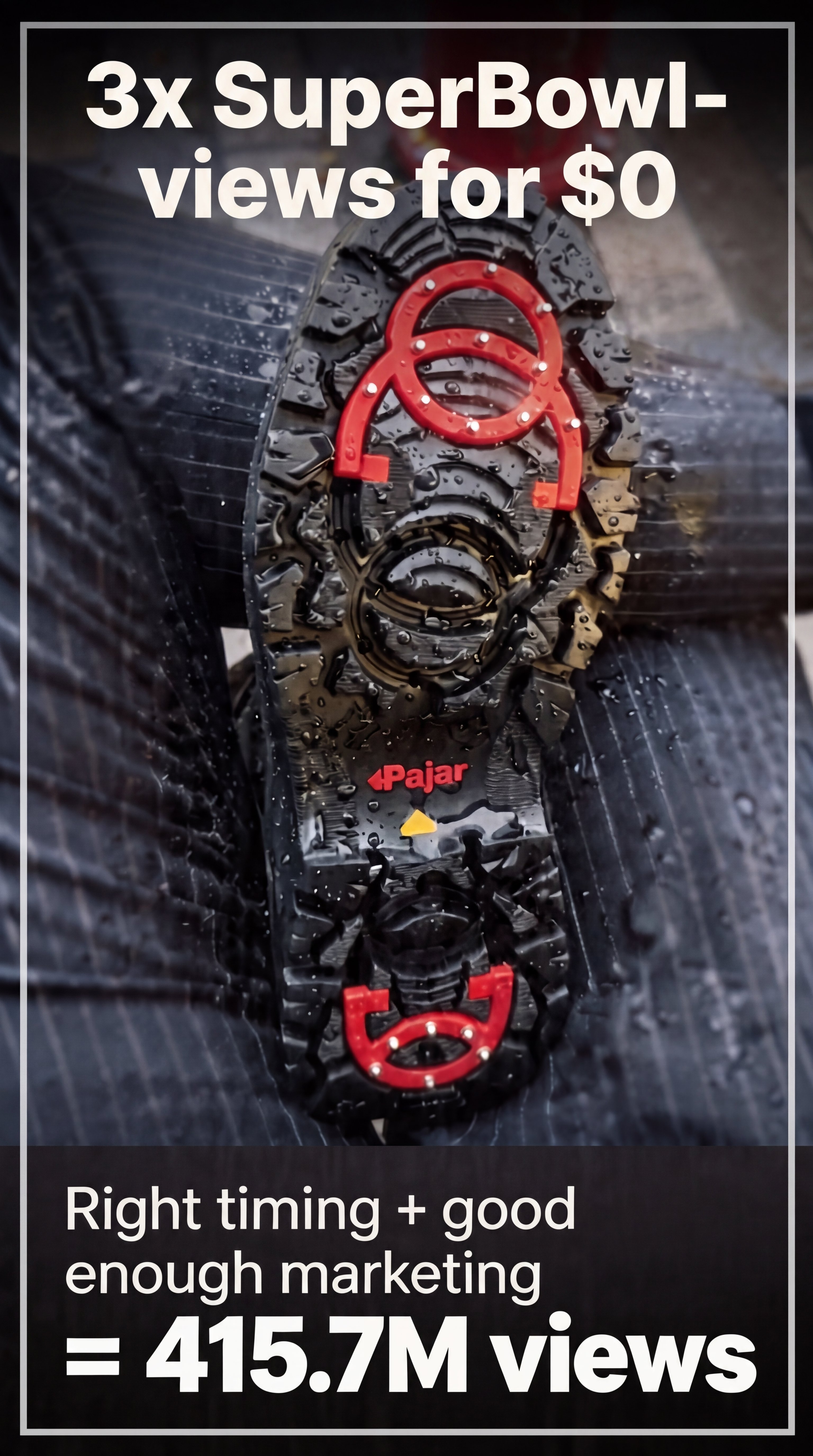
Three months ago, we posted a video for Prato Footwear — a Montreal-based boot retailer. Not a manufacturer. Not Nike. Not Converse. A retailer that doesn’t even make the products they sell.
The video hit 334M+ on YouTube Shorts, and 415.7M+ across all platforms. 89% of that reach landed in the US and Canada — the exact markets they needed. And here’s the part most people miss:
They’re outperforming brands like Nike, Converse and Pajar in organic engagement. As a pure retailer. No factory. No celebrity deal. No paid media.
The ‘good enough’ is intentional. Overproduction kills authenticity. Authenticity is what the algorithm rewards.
We’ve analyzed thousands of viral videos — everything from 10M to 1B+ views across our full client base. They all follow the same 3 patterns. This video hit all three at once.
The 3 patterns behind every viral video
The best videos don’t hide the outcome. They show it immediately. Within the first second, your brain already knows what’s going to happen — and stays anyway, to collect the dopamine hit when it does.
That’s why cooking videos, transformations, and “satisfying” content dominate short-form. The payoff is visible before the setup is even finished. The brain has already committed, so it stays.
The Prato video opens on a boot sole. You know exactly what you’re about to see. You watch all 12 seconds anyway.
Virality isn’t random — it’s contextual. We tied the visual to weather patterns: a rain → snow transition. We didn’t specify a location. We didn’t have to.
The algorithm did the rest — pushing the video to users already consuming weather-related content. People already thinking about what they’d wear when temperatures dropped. The intent was already there. We just showed up at the right moment.
Timing isn’t just about when you post. It’s about matching your content to what your audience’s brain is already occupied with.
Something slightly “wrong” increases retention. Cognitive dissonance creates a pattern interrupt — the brain notices the mismatch and locks in instead of scrolling.
It creates friction → attention → engagement. Brands like Duolingo and Scrub Daddy have built entire content strategies around this mechanism. Used carefully, it’s one of the highest-leverage tools in short-form video.
For Prato: showing the underside of a boot, soaking wet, up close — instead of a lifestyle shot. It stopped the scroll because it wasn’t what the brain expected.
There’s more behind this
These three patterns are the foundation. But behind every video we make there’s also a layer of retention loop psychology, caption architecture, platform-specific sequencing, and timing data that tells us exactly when to publish to ride the wave rather than miss it.
We can break down the exact structure behind the 415M video in detail if there’s interest. Or if you want us to just do it for your brand — the link is below.